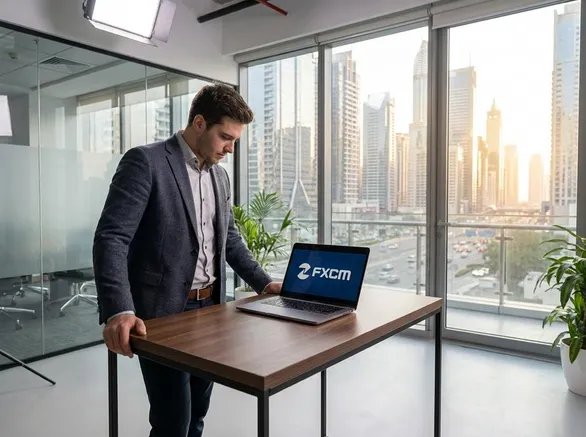
FXCM India: TradingView Integration and What You Need to Know
Use TradingView charts and tools directly on FXCM. Commission-free trading from 0.8 pips. See how it works and what to check before signing up.
Visit FxPro

FXCM India: Who Operates the Broker and What Protection Exists?
If you are an Indian resident considering FXCM, the first thing to know is that your account would be opened with Stratos Global LLC, a company registered in St. Vincent and the Grenadines (SVG). FXCM itself was founded in 1999 in New York and is now part of the Stratos/Jefferies group. However, the entity serving clients from India is offshore and not regulated by SEBI (Securities and Exchange Board of India). This means no local oversight, no investor compensation scheme, and no requirement for segregated client funds or negative-balance protection.
On a practical level, this changes the risk equation. While the TradingView integration, commission-free model, and 1:1000 leverage may look attractive, you are operating outside the legal framework that protects Indian residents trading on SEBI-recognised exchanges (NSE, BSE, MSE). The Reserve Bank of India (RBI) and SEBI prohibit offshore brokers from soliciting Indian residents for over-the-counter (OTC) margin forex and CFD trading. Using FXCM from India is not per se impossible technologically, but it carries legal and financial risks that you should fully understand before depositing a single rupee.
Is FXCM Regulated in India?
No. FXCM has no SEBI registration and no branch or subsidiary in India. Offering OTC margin forex to Indian residents violates the Foreign Exchange Management Act (FEMA) and SEBI's regulations. The RBI maintains an 'Alert List' of unauthorised forex trading platforms; as of 19 November 2026, the list contained 95 entities (including Starnet FX, CapPlace, Mirrox, Fusion Markets, Trive, NXG Markets, Nord FX, and others added that month). The RBI explicitly states the list is not exhaustive. FXCM is not named on that list at the time of writing, but its Indian-facing operations remain outside the legal channel.
What this means for you:
- Deposits to FXCM cannot legally be sent under the Liberalised Remittance Scheme (LRS) – margin forex is not a permitted end-use.
- The broker is not required to segregate client funds; in an insolvency, you may not recover your money.
- There is no negative-balance protection – losses could exceed your deposit.
- Enforcement Directorate (ED/FEMA) authorities have acted against facilitators of unlicensed forex trading in the past.
How to Open an Account and Fund It? Key Details
Opening a Standard account with FXCM requires a minimum deposit of USD 50. The base currency is USD, EUR, or GBP – not INR. This means each deposit and withdrawal incurs currency conversion costs. Local Indian payment methods (UPI, IMPS, NEFT) are not verified at the time of this review; only international wire and card deposits are available. The table below summarises what you can expect.
| Feature | Detail |
|---|---|
| Minimum deposit | USD 50 (approx ₹4,250 as of review) |
| Base currencies | USD, EUR, GBP – no INR |
| Local payment rails (UPI/IMPS) | Not verified; likely unavailable |
| Accepted methods | Credit/debit cards, international bank wire |
| Deposit processing time | Cards instant; wire 1–5 business days |
| Withdrawal time | Typically 1–3 business days after request |
| Account verification | Standard KYC: PAN, Aadhaar, address proof, bank account proof |
Funding practicalities:Because remitting money abroad for margin forex trading is not permitted under LRS, any transfer you make technically falls outside the law. Additionally, a 20% Tax Collected at Source (TCS) applies on foreign remittances above ₹10 lakh per financial year (threshold raised from ₹7 lakh effective 1 April 2026). You could face income tax scrutiny on the source and purpose of the funds.
TradingView and Commission-Free Trading: What You Can Expect
FXCM offers three platforms: MetaTrader 4, its proprietary Trading Station, and – notably – TradingView. TradingView is a powerful charting and analysis platform popular among retail traders worldwide. Integration means you can use TradingView's custom indicators, drawing tools, and screeners directly to execute trades on FXCM. This is a clear advantage for traders who prefer TradingView's interface over MT4 or web-based platforms.
| Platform | Strengths | What's Missing |
|---|---|---|
| TradingView | Social features, advanced charting, custom scripts | No MT5 |
| MetaTrader 4 | Automated trading (EAs), huge community | Older interface |
| Trading Station | FXCM's own platform, integrated news | Less third-party support |
Costs are commission-free; FXCM makes money through the spread. On major forex pairs like EUR/USD, spreads start from 0.8 pips and average 0.3–0.6 pips. This is competitive but not the tightest in the industry. No standard bonus or promotion is offered to offshore clients.
Leverage and Risks: Understanding the Numbers
Leverage on FXCM for Indian clients is set to 1:1000 by default and automatically reduces to 1:400 for accounts with equity above USD 5,000. This is extreme compared to the roughly 20–30x leverage available on SEBI exchange-traded currency derivatives. High leverage amplifies both gains and losses – a 1% move against your position at 1:1000 could wipe out your entire deposit.
| Scenario | Trade size | Margin required at 1:1000 |
|---|---|---|
| 1 lot EUR/USD ($100,000 notional) | $100 | |
| At 1:1000 | $100 margin | |
| 1% adverse move = $1,000 loss (10x margin) |
Beyond leverage, consider the lack of segregated accounts and the absence of a compensation scheme. These are standard protections in regulated jurisdictions (e.g., FCA, CySEC). Without them, your funds are at greater risk if the broker encounters financial trouble.
Tax Considerations for Indian Traders
Even if you trade with an offshore broker like FXCM, you remain an Indian tax resident and must report your worldwide income. Here's what applies:
- Forex/CFD trading profits are generally treated as non-speculative business income and taxed at your slab rate (if held beyond intraday). Losses can be carried forward for 8 years.
- If you trade intraday (same-day positions settled), those are speculative business income – losses can only be set off against speculative gains and carried forward 4 years.
- You must declare foreign assets and bank accounts in your Income Tax Return (Schedule FA).
- The 20% TCS on LRS remittances (over ₹10 lakh/year) is a credit against your final tax liability – but again, margin forex is not a permitted LRS purpose, so the entire remittance could be questioned.
Key message:Trading with an unregulated offshore broker does not relieve you of Indian tax obligations. Keep detailed records of every trade, deposit, and withdrawal.
Limitations Worth Knowing
No broker is perfect, and FXCM's India offering has clear constraints:
These are not deal-breakers for every trader, but they should factor into your decision.
Who Should Consider FXCM? A Constructive Verdict
Makes sense for
Traders who are very experienced with high-leverage forex, fully understand the absence of regulatory protection, and are comfortable operating outside the Indian legal framework. If you have a clear risk management plan, use only money you can afford to lose, and value TradingView integration over regulatory safety, FXCM offers a low-minimum, commission-free entry. You must also be prepared to handle tax compliance on your own.
Best skipped by
Anyone who prioritises fund safety, wants to trade legally within India, or is new to trading. The combination of unregulated status, extreme leverage, lack of fund segregation, and potential legal issues makes FXCM unsuitable for most Indian residents. If you are looking for a secure, regulated environment, consider a SEBI-registered broker for exchange-traded currency derivatives (legal, protected, INR-based) or a strictly regulated international broker with FCA/CySEC/ASIC oversight (though even those may not be permitted under FEMA for Indian residents). Always verify the current RBI Alert List and consult with a compliance professional before committing any funds.
Key trading conditions
| Local regulation | Unregulated (offshore) |
| Minimum deposit | Min USD 50. |
| Max leverage | Up to 1:1000 default |
| Instruments | FX, indices, commodities, crypto CFDs, shares. |
| Platforms | MT4, Trading Station, TradingView (no MT5). |
| Base currencies | USD, EUR, GBP |
| Islamic account | Yes. |
| Spreads & commissions | Commission-free |
Side by side
| Feature | FXCM | FxPro |
|---|---|---|
| Trading platforms | MT4, Trading Station, TradingView (no | MT4, MT5 and cTrader |
| Regulation | Unregulated (offshore) | FCA (UK), CySEC, FSCA |
| Leverage cap | 1:1000 | 1:200 max |
| Minimum deposit | USD 50 | USD 100 |
| Accepts local clients | No | Yes |